Plenty of footage looks bright enough and still feels flat and cheap. The talent’s face is even and without dimension, while the colour of the product packaging drifts away from the real thing. Problems like this can rarely be repaired in the edit. Commercial video lighting, it turns out, involves far more than the sheer amount of light.
The consequences show up immediately in the final result. The brand looks less convincing, and repeated revisions eat into the team’s time. Even visual effects work gets held up when the lighting was never controlled in the first place. Fixing badly lit material is always more expensive than lighting it properly to begin with.
The good news is that the principles can be learned. The character of light is determined by a handful of measurable variables. The discussion below breaks down those variables and what they do on set.
Why Commercial Video Lighting Does Not Stop at Brightness
Modern cameras are already highly sensitive in low light. That is why the main problem is rarely a lack of brightness. What matters far more is how that light falls and spreads. This difference is what makes two pieces of footage feel worlds apart in quality.
Contrast is what creates dimension
Objects look three-dimensional because they have a bright side and a dark side. Switching on every light actually erases that distinction. The ratio between key and fill light is usually set deliberately. A gentle ratio suits a company profile, while a high ratio delivers drama.
The Variables That Define the Character of Light
There are four things to decide before any lamp is switched on. All four influence each other and cannot be chosen in isolation. A mistake in one of them is hard to cover with another.
Source size and its distance
Soft light does not come from expensive fixtures, but from a large source. That size is judged relative to the subject, not in absolute terms. Moving the source closer makes the light feel softer while also falling off faster. That distance is what controls how quickly the background goes dark.
Colour quality, the factor most often ignored
Cheap lamps frequently have an incomplete colour spectrum. As a result, skin tones and packaging colours shift in ways that cannot be fully corrected. Colour quality standards for broadcast work are discussed by technical bodies such as the EBU. Using fixtures with good colour quality is far cheaper than trying to fix the problem later.
Mixed colour temperatures
Window light and room lighting have different colour temperatures. When they mix, white balance cannot be correct for both. One side of the face turns bluish while the other goes yellow. The solution is to unify the sources or block one of them from the start.
The direction the light comes from
Direction determines the texture that appears on a surface. Light from the side emphasises the weave of fabric and the detail of materials. Light from the front flattens everything, including whatever you wanted to highlight. The choice of direction therefore always follows the message you want to convey.
Problems That Regularly Crop Up on Location
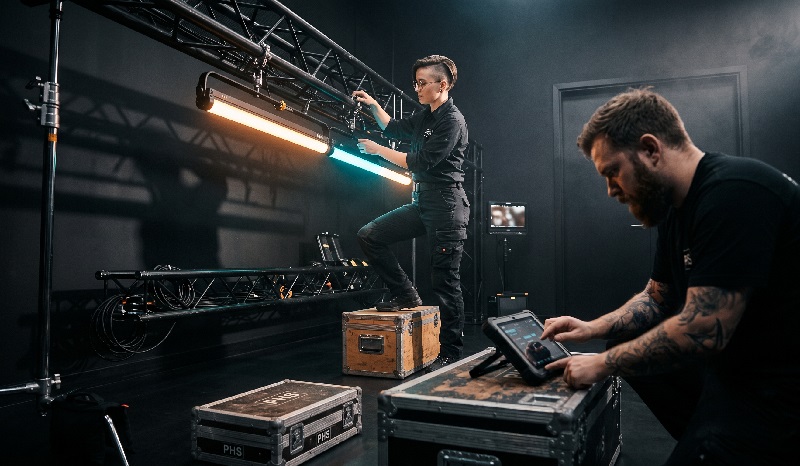
Most complaints about footage follow the same recurring patterns. Recognising the symptoms helps the team make decisions faster.
Symptoms, Causes, and How to Handle Them
| Symptom on screen | Common cause | Fix on location |
| Flat image with no dimension | Fill light is too strong | Reduce the fill or move it further away |
| Hard shadows on the face | Source is too small | Enlarge or diffuse the source |
| Product colour is off | Poor colour quality in the lamps | Change the fixtures, do not rely on correction |
| Flickering bands in the image | Lamp frequency does not match | Adjust the shutter or change the lamps |
| Blown highlights with no detail | Overexposure | Bring the intensity down while recording |
Special treatment for glossy products
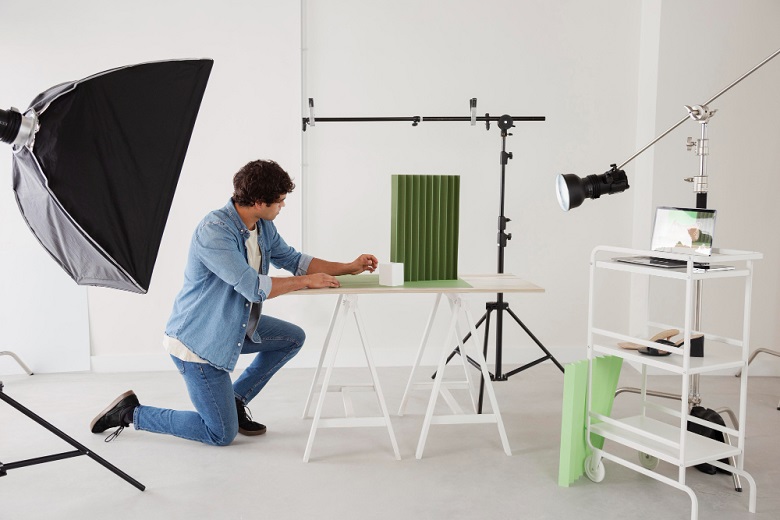
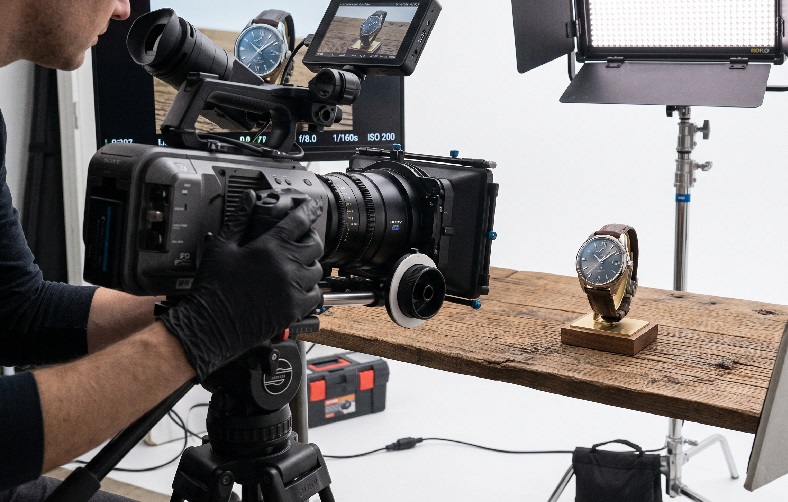
Glossy surfaces do not reflect the lamp; they reflect the shape of the source. What you are really lighting, therefore, is the reflection rather than the product. A large diffusion panel usually gives the cleanest result. A dark surface on the opposite side is used to define the product’s edges.
A Lighting Sequence That Stops You Going Back and Forth
The following flow saves time on location:
- Switch off all the lamps, then observe the available natural light.
- Decide the direction of the key light based on the mood you want.
- Set the fill light until the contrast feels right.
- Separate the subject from the background with a backlight if needed.
- Check the result on a monitor, not on the small camera screen.
The first step is the one most often skipped because it feels like wasted time. Yet adding lights on top of conditions you have not understood only makes the job longer. Experienced digital content production teams usually turn this step into a habit.
A colour check is also best carried out before the full shoot begins. Recording a short test and reviewing it saves a great deal of revision time.
A few things are worth noting down before the team starts packing up the gear:
- the position of each lamp and its distance from the subject
- the colour temperature settings in use
- notes on any changes made partway through the shoot
These notes are a real help if additional footage is needed on another day.
Treating Commercial Video Lighting as an Early Decision
The image quality of a commercial advertisement is determined long before the edit. Brightness is only the most basic requirement, while direction, softness, and colour quality define the final impression. This decision also affects cost, because revising the lighting means reshooting. Planning it early is a form of saving that rarely gets recognised.
Every brand has a different visual character. High Angle regularly helps clients translate that character into a clear lighting plan. Involving the digital content production team from pre-production means technical requirements are identified much earlier.
For brand owners, a short technical discussion before the shoot usually has more impact than adding more lights. Commercial advertising that looks convincing almost always starts from calm preparation.
Frequently Asked Questions
- Do expensive lamps automatically give better results?
No, because source size, distance, and colour quality matter more than the price tag. - Why does a product’s colour shift on camera?
Because the lamp’s spectrum is incomplete, so some colours are not reflected accurately. - Can poor lighting be fixed in the edit?
Some of it can, but detail lost in the brightest areas cannot be brought back.